
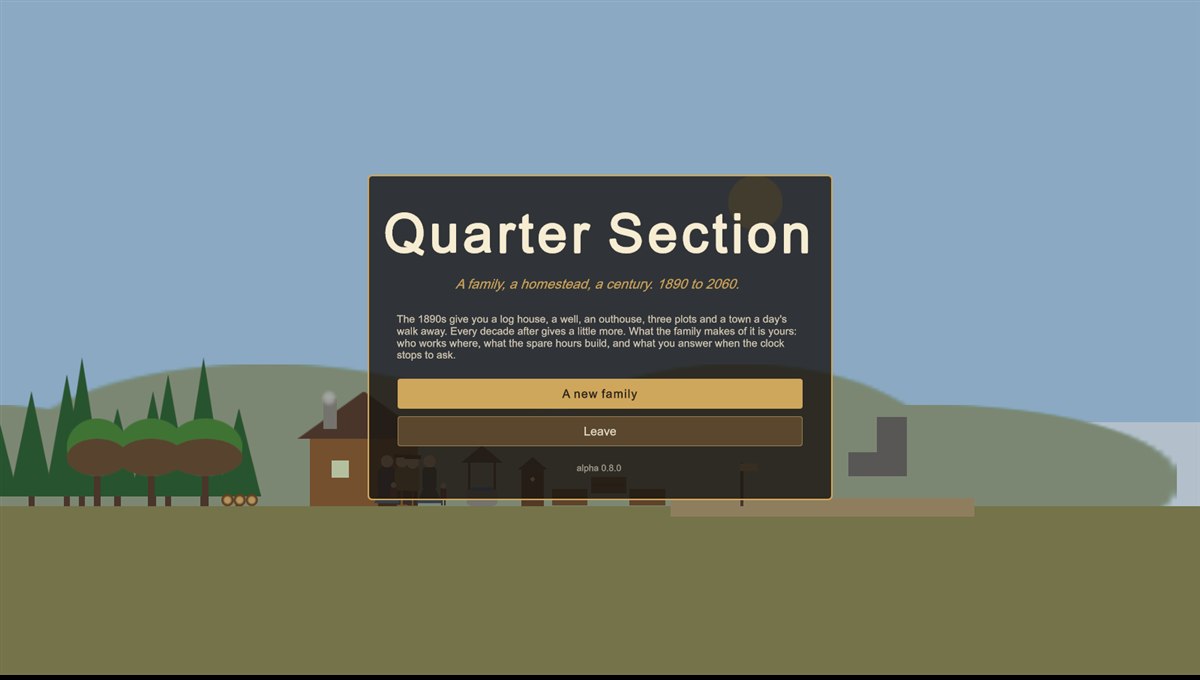
A quarter section is the 160 acres a family got under the Homestead Act, if they could hold it. Quarter Section gives you one in 1890: a log house, a well, an outhouse, three plots and a town a day’s walk away. Every decade after gives a little more. What the family makes of it is yours: who works where, what the spare hours build, and what you answer when the clock stops to ask.
The 1890s are meant to hurt. Water is carried by the bucket, the housework takes half of every day, and a birth or a fever with the man away in town can undo a year. Then the wire reaches the street, the doctor comes to town, the car cuts the road to three hours, and the century’s own troubles arrive on schedule: the flu of 1918, the crash, the wars, the long summer.
This is an alpha. Play it, break it, and tell us where.
Play It
Play in the browser Download for Windows (zip, 39 MB)
In the browser: Chrome, Edge or Firefox on a desktop. About 17 MB loads once; nothing is installed. The game saves itself as you play - twice a minute, at every season’s start, and after every card you answer - in your browser’s storage for this site, one slot per family, and the title screen lists the families you can continue. A save from 0.8 is brought forward. Clearing the site’s data clears the saves.
On Windows: unzip anywhere and run QuarterSection.exe. The build is not signed, so Windows may show “Windows protected your PC”: click More info, then Run anyway. The saves live under your user profile’s AppData, one per family, written as you play - twice a minute, at every season’s start, after every answered card, and whenever the window loses focus or you leave. A save from 0.8 is brought forward.
How It Plays
The household is people, not a number. Each has an age, a constitution, a health, and hours in the day. The man in town earns cash and is not at home; the wife at home carries water and keeps the house, and cannot also be in the garden. A child is a mouth for years before it is a pair of hands. Hands are the scarce thing.
Every decade is a ladder. Eight tracks, from shelter to work, each with rungs the calendar unlocks and the household has to afford: a second room, a horse, indoor plumbing, the doctor’s house calls, the car, the tract house. A rung costs cash, materials and hours, and moves the numbers the family lives under from then on.
The household keeps your standing orders. How much wood to hold on the pile, how many days of food to keep back from the cart, the cash the tin must not go below, the acres in the cash crop and the prairie to break each spring, up to a hundred, and whether the family takes the children as they come or stops at so many: set them once in the settings menu and the household runs them until you change them. A family that stops holds back by restraint before the pill, which fails about one year in ten, and by birth control once the town has it.
The clock stops to ask. A fever, the first snow with the pile short, the harvest week with a thin larder, the county’s due the tin could not cover, a sickness in the county: the game stops and offers two to four answers, each priced in what the house actually holds. Every birth can be named. Every death is noted, with its cause and its cost.
The land is yours to add to, or to part with. Five years’ residence earns the patent. From then the build list offers the west forty for sale, forty acres at a time at the county’s price for the decade, and offers the north forty for cash when buying it is not simply spending: not while a parcel of your own grass lies unbroken, not while the hands cannot cut what is already ploughed, and not when the price would leave the tin short of January. When you hold the price and one of those is what stands in the way, the row is still there with the reason on it and nothing to press; when you can take it, it says what it leaves behind first. and once a decade a neighbour quits and offers their forty on a note: a third down, the January payment taken before the county’s due, and three missed Januaries in a row and the bank takes the parcel back. The place line at the head of the right panel says what the estate is worth, and the tax follows the acres you actually hold.
The ground pays in money now. Break the prairie, at 45 hours an acre by hand and 12 behind a team, and sow winter wheat: drilled from mid September, standing ripe on 15 June, cut in a window that shuts on 10 July, threshed until the end of August. Seed is bought at sowing whether or not the year comes in, what is not cut in its window is lost, and the wheat sells at the elevator on the cart’s own trips, the cart asking what goes on it before it leaves: so many bushels, so many days of food, the price the pair will fetch, and how many loads it takes, for a big bin means several loads in a trip and every load is paid for in the hours the road takes from the days that follow. An eighth ladder, from the walking plough and cradle to the autonomous rig, cuts the hours an acre takes; a machine’s keep runs at a seventh of its price a year, which is what makes buying it before you have the acres a trap. From the 1900s the seed goes on the merchant’s account when the tin cannot pay for it, settled first at the elevator when the crop is sold, and the household hauls the crop in as many loads as the week’s hours allow. The field is on the rise behind the yard, and its colour follows the crop.
A run can be finished. Reach the 2060s and the century the title promises is over: the run closes and the books close with it, with an account of the whole of it - how long the family held the quarter section and who was in the house at the end, how many generations and who was at the head of them, how many born and buried and married away, how much prairie was broken and how much wheat came off it, and what the place came to against the $1,890.25 the first of them stood up with. A family that held it keeps its file on the title screen; one that died out does not.
The numbers are real. Every wage, price and tax is a published series in constant 1890 dollars: a farm hand’s day, a gallon of kerosene, 160 acres of county tax, a doctor’s call, the Model T. The people are not; every name comes from a list.
What To Tell Us
Every run is reproducible from its number. When something is wrong, or just odd, send the version, the land’s number and the year from the title and naming screens, and what happened. “0.17.1, land 17, 1903, the county’s due card said I owed twelve dollars I had” is enough to replay the exact run.
Also welcome: where it was boring, where a card asked something you had no way to judge, and what you wished the household could do. The 1890s are meant to hurt; say if they hurt for a reason that felt unfair.
Send it on Discord or by email; both are at the foot of this page.
Part of the RavenIron Suite
Every RavenIron project is engineered server-authoritative in C# and .NET, and shares the same forge.